The Fitting Room
From le smoking to the abaya: Marrakech’s couturiers and cutters
Saint Laurent’s archive, Norya Ayron’s abaya, 33 Rue Majorelle and the kissariat of the souks.

Photo Credit
Image courtesy of © Viault · CC BY-SA 4.0 via Wikimedia CommonsYves Saint Laurent and Pierre Bergé bought the Jardin Majorelle in 1980, and the street beside it now holds the couturier’s museum. Around it, Marrakech cuts cloth at every level: a designer who set out to modernise the abaya, a concept store of young Moroccan labels, and the kissariat of Souk Semmarine, where caftans, djellabas and jabadors hang by the rail. Checked against official pages in November 2026.
The couturier’s archive
Yves Saint Laurent was born in Oran on 1 August 1936, joined Christian Dior as his assistant in 1955 and showed the first collection of his own house on 29 January 1962. Then, as his Marrakech museum puts it, he invented the modern woman’s wardrobe: the pea jacket and trench coat in 1962, le smoking in 1966, the safari jacket and the first trouser suit in 1967.
He was also, the museum says, the only couturier of his generation to archive his work systematically. From 1964 he set aside prototypes from every collection: the model made by his workshops for the runway, not the version later fitted to a client. It is the reason his clothes can be seen at all, and the reason a museum stands beside a garden in Marrakech.
The permanent hall covers 400 square metres. Christophe Martin set fifty pieces against black around themes the couturier loved, among them Masculine-Feminine, Africa and Morocco, Imaginary Voyages, and Gardens, and the garments are rotated regularly to protect them. You see the pea coat and the safari jacket as their maker kept them, which is to say perfectly.
Even the bookshop is cut to measure. It reinterprets Saint Laurent Rive Gauche, the first ready-to-wear boutique to bear a couturier’s name, which Isabelle Hebey designed in 1966 with ox-blood partitions, brushed aluminium displays, Noguchi paper lamps and mirrored walls. Payment is by card only: a bookshop that takes cards only, in a city that otherwise runs on conversation.
The abaya, modernised
Norya Ayron’s first design, in her own words, was a modern take on the traditional abaya in printed, coloured fabric, worn as a casual dress, and it was a great success. She remembers the American artist Mos Def telling her she would democratise the abaya; today she dresses women of every nationality, belief and age in it.
A bookshop that takes cards only, in a city that otherwise runs on conversation.
The house style is simple lines and clean design, inspired by Morocco, the desert, the light, the medinas and Berber jewellery. The first collection was made in ten days with local fabrics; the label now designs and produces its own, certified to the Oeko-Tex standard, and is working with painters on its next prints. Its boutiques are in Gueliz, at 17 Rue Tariq Bnou Ziad, and in the medina, and La Mamounia stocks it too.
The concept store and the kissariat
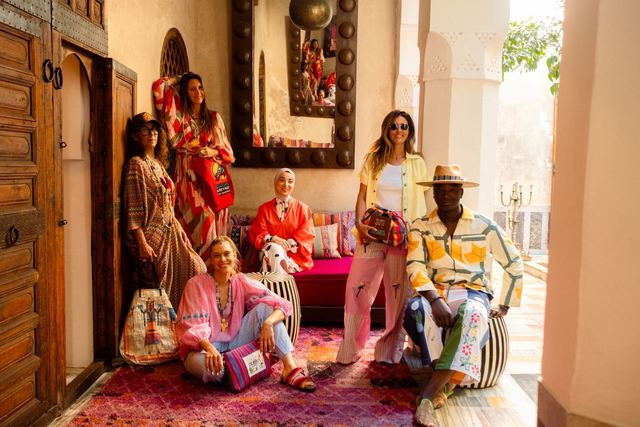
Opposite the garden, 33 Rue Majorelle is a gallery and concept store for up-and-coming Moroccan brands. Its rails run from caftans and gandouras for women to caftans, long shirts and traditional Moroccan jackets for men, with babouches for both: a short course in Moroccan tailoring, edited for people who would rather not get lost to find it.
Getting lost has its rewards, though. The Regional Tourism Council’s route through the souks starts in Souk Semmarine, once the market for fabrics and woollen yarn, where the nearby kissariat sell caftans, djellabas and jabadors. It continues to the dyers’ souk, where wool and silk threads are dyed in great vats, and to Souk Elghzel, the old wool market, now a meeting place for women artisans.
Our advice: book the museum first, through the Jardin Majorelle’s official ticket site, which is the only one that admits you; cross to 33 Rue Majorelle afterwards, and keep a morning for the souks, to see the cloth before you see the cut.
Why it's on our list
- The couturier’s archive
- The abaya, modernised
- The concept store and the kissariat
Location
The map comes from Google Maps, which sets its own cookies once it loads.
More in depth
 The Fitting RoomLinen by day, a jacket for the Atlas: what Marrakech asks you to wearDress for the medina, the palace bars, the pools and the mountains, from official sources.
 The back storyMarrakech at the table: tagines, terraces and the night marketLa Mamounia, Al Fassia, roof terraces and the night square.
 The back storyMoroccan FoodTagine, couscous, pastilla, tanjia and mint tea.