Objects of Desire
Brick lace and a garden with its own water: the houses Marrakech builds and saves
Studio KO’s brick façade, Le Jardin Secret’s rescued riad and the new villas beyond the walls.

Photo Credit
Image courtesy of © muffinn from Worcester, UK · CC BY 2.0 via Wikimedia CommonsWhat does a city of courtyards build next? In Marrakech the answer is buildings that look inward and dress well: a museum façade of brick laid like the weft and warp of cloth, a nineteenth-century riad restored with its own water supply, a palace renewed for its centenary and villas in tadelakt among the olive groves. No prices here, only buildings, checked against their own pages in November 2026.
A façade cut like cloth
When Studio KO, the French firm of Karl Fournier and Olivier Marty, designed the Musée Yves Saint Laurent Marrakech, they started in the couturier’s archives. They were struck by the tension between curved and straight lines, loose and precise cutting, and built it into the walls: an intersection of cubes wrapped in a lace of brick whose patterns recall the weft and warp of fabric.
Inside, the museum says, the building changes character the way a couture jacket does at its lining: velvety, smooth and radiant. It covers 4,000 square metres, with a 400-square-metre permanent hall designed by Christophe Martin, a research library of more than 5,000 volumes and a terrace café. It is a museum that dresses like its subject.
The same architects who invented a façade gave a brasserie its old one back. In Gueliz, Studio KO restored Le Grand Café de la Poste, a 1920s grand café taken over in 2005, by moulding themselves to the existing building: wooden stairs, shutters and ceiling fans, and no flourish the original would not recognise.
The riad that kept its water
Le Jardin Secret, on Rue Mouassine, stands on ground the Saadians began to build on in the second half of the sixteenth century. That palace was destroyed late in the seventeenth; a new one rose in the nineteenth on the old Saadian plan, then decayed after 1934. The idea of restoring it took root in 2012, and the garden opened to the public eight years later.
Its surfaces are a lesson in Marrakech building: tadelakt plaster over brick and rammed earth, zellige and bejmat tiles from Fez, inlaid cedar and hand-carved stucco. A private hammam, a qubba and a tower once advertised the owner’s wealth; the tower rises as high as some of the city’s minarets, and the garden says almost no other building of its kind survives in Marrakech.
The real luxury was invisible. In the eleventh century the Almoravids dug the city’s first khettara, a tunnel that intercepts groundwater and carries it to mosques, hammams and fountains. A few great houses were connected too, Le Jardin Secret among them, so it had its own water supply; its pipes, reservoirs and channels are still there to see.
The same architects who invented a façade gave a brasserie its old one back.
A palace renewed
La Mamounia has spent a century reinventing itself without changing its address. The designers Patrick Jouin and Sanjit Manku carried out its metamorphosis in 2020 and 2023, and the Centenary Chandelier that greets you at the entrance is a luminous sculpture in homage to traditional Berber jewellery. Behind it, the gardens still sit within twelfth-century ramparts.
New houses beyond the walls
Beyond the walls, the architecture turns outward to the Atlas. Amanjena Residences, at kilometre 12 on the Route de Ouarzazate beside the 27-hole Amelkis course, are villas of two to five bedrooms by SAOTA in lime-washed oak, stone, bronze, travertine and tadelakt, each with a garden, pool and roof gardens. At Royal Palm Marrakech, villas of two to six bedrooms are set around a golf course.
Royal Palm adds a five-star hotel, the Fairmont Royal Palm, a country club and the Jardin Ocre to its villas, and in both places the selling point is the view: outside the walls, the High Atlas does the job the minaret does in town, and it comes with every bedroom.
Our advice: see the old house before the new ones. Le Jardin Secret opens from 9.30am to 5.30pm in November and December, and its tower is visited with a separate ticket at the time printed on it.
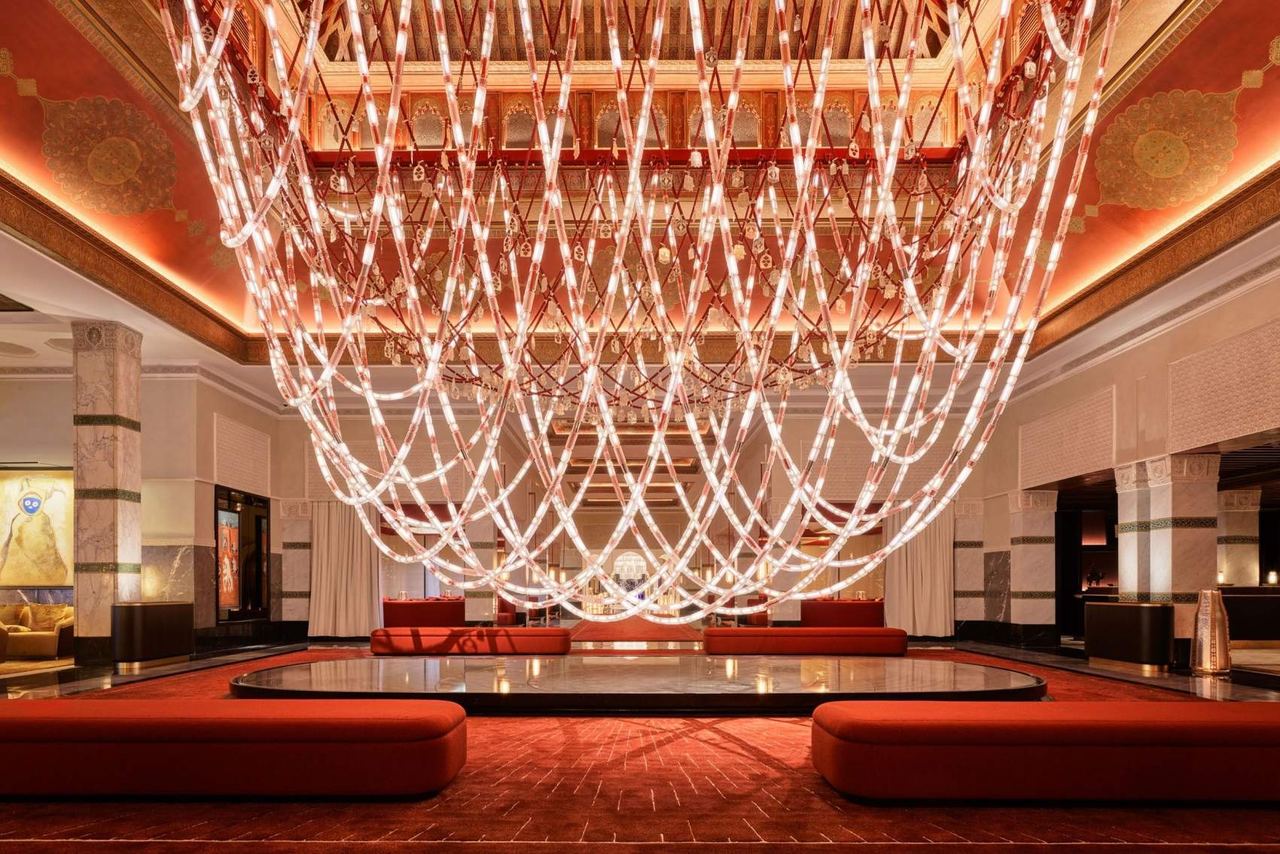
Photo Credit
Image courtesy of © La MamouniaWhy it's on our list
- A façade cut like cloth
- The riad that kept its water
- New houses beyond the walls
Location
The map comes from Google Maps, which sets its own cookies once it loads.
More in depth
 Objects of DesireA bar that thinks it is a train, and the Margarita two waysThe IBA Margarita, El Fenn’s Moroccan twist, and the palace and roof bars that pour them.
 Objects of DesireLess parked than crouched: the electric Jaguar and the new supercarsJaguar’s Type 00 and Type 01, Ferrari’s first electric car and the record-breakers around them.
 Objects of DesireA square that talks and a hall built from a film: how Marrakech listensJemaa el-Fna’s storytellers, Studio KO’s auditorium, palace jazz and a rooftop DJ.